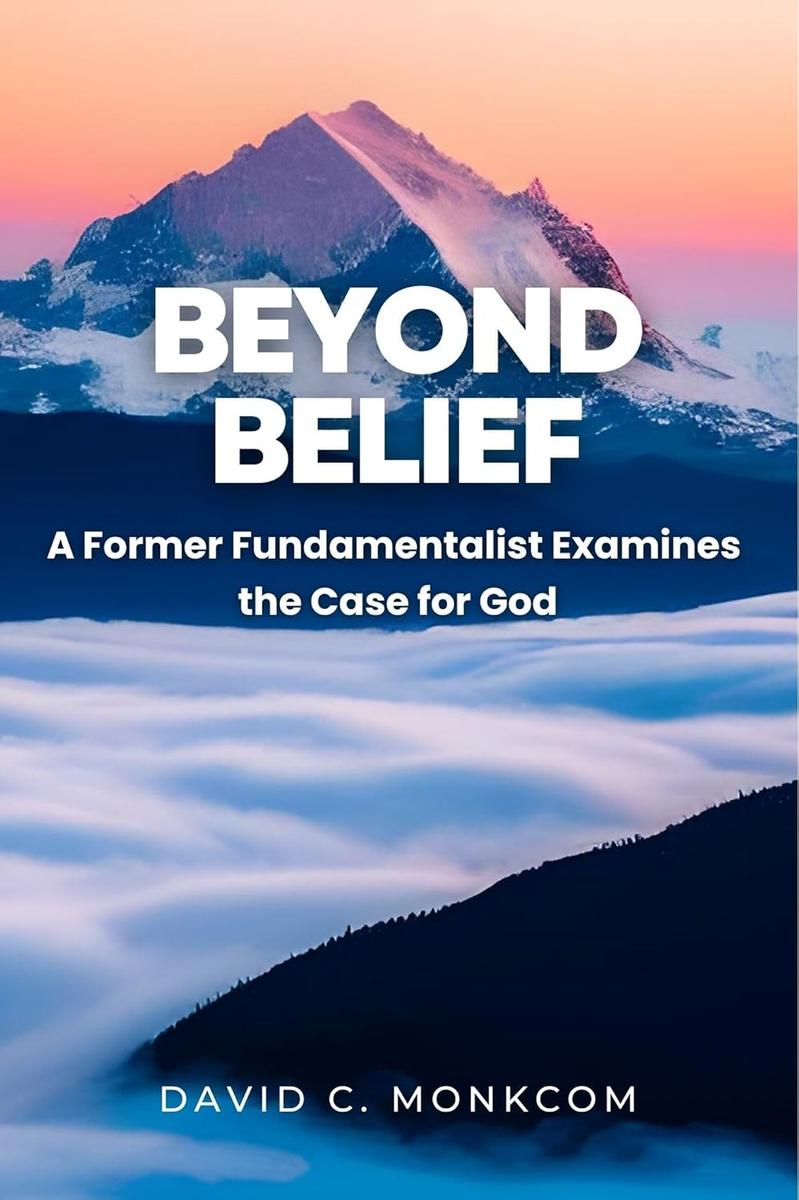
Beyond Belief: A Former Fundamentalist Examines the Case for God
20 September, 2023
“Beyond Belief” is my first published work. It’s part memoir and part discussion of one of the oldest and trickiest questions human beings have ever asked: “Is there a God?”.
Part One, “A Journey”, is about my upbringing in the dogmatic world of fundamentalist Evangelical Christianity, and how I finally got away from it.
In the world to which my parents belonged, truth was to be found not by questioning or reasoning but by reading and believing the Bible and taking it literally. Any other kind of theology was “error” and unbelievers were bound for hell. The teaching of fundamentalist leaders was not to be questioned: you either accepted it or were excommunicated.
In short, theirs was a community of closed minds and shuttered lives. Breaking away from that community and that mindset was, for me, a deeply challenging but also liberating journey which led me, ultimately, to Humanism.
In Part Two, “A Conversation”, I invite readers to consider whether religious dogmatism is ever justifiable. Can religious claims such as God’s existence be substantiated? Do holy scriptures, miracles and personal religious experience give us grounds for claiming that our religion is true? These may seem tough philosophical questions, but don’t be put off: philosophy doesn’t have to be nerdy! It can be (as you will discover if you read the book) an entertaining, enlightening and very enjoyable conversation.
My conclusion (spoiler alert here!) is that dogmatism and fundamentalism are not only unjustifiable but also downright dangerous. Fundamentalist indoctrination damages individuals and creates closed faith communities that act as echo chambers and can even spawn terrorism. If we want a peaceful and tolerant world, we need to break open the echo chambers and tear down the barriers between communities. Ditch dogmatism and embrace dialogue. Seek to understand, not demonize, one another.
So, my appeal to believers of all kinds, and to sceptics too, is this: let’s start listening to one another. Why not set up neighbourhood dialogue groups where we can get to know one another and begin to understand each other? And what better way to begin than by discussing this book?!
Available as Paperback

Available as Ebook
Reviews
A Christian’s view
As a committed Christian I respected and admired the persuasive arguments of a former fellow student who struggled to escape from his bigotted upbringing. For such a serious subject I found the book almost convincing and entertaining.
Bryan Dawson
Extracts from the book
INTRODUCTION: WE NEED TO TALK
On the morning of Tuesday 22 March 2016, Islamic State suicide bombers attacked Brussels airport and a Metro station, killing thirty-two people (in addition to themselves) and injuring more than 300. When the attacks took place, I was on a tram heading into the city: had I left home slightly earlier, I could easily have been among the dead or wounded. That narrow escape brought home to me, very vividly and personally, the dangers of fundamentalism. It’s one reason why I decided to write this book.
The other reason is that I was brought up in a fundamentalist organization. Not a terrorist group, but a radical Christian movement. Almost a sect. They weren’t dangerous in the same way: they didn’t plant bombs. Instead, they planted dogmas in their children’s minds and told us (in the nicest possible way, of course) that we’d go to hell if we didn’t believe. To keep us on the right track, our parents restricted our exposure to outside influences. We were surrounded by believers, taken to religious meetings every Sunday and immersed daily in scripture reading and prayer.
It’s a very effective method of programming: as the Bible says, “Train up a child in the way he should go and, when he is old, he will not depart from it.” Even if, in time, you come to question or indeed reject the dogmas, fear of the consequences can make it very hard for you to leave your faith community. For those who do leave, it may take a lifetime to get over the withdrawal symptoms – the apostate’s guilt, and the shame of being the ‘black sheep’ of the family. That was my own experience, growing up in the mid-20th century, and I describe it in the first part of this book.
Although the world has changed in many ways since then, dogmatic fundamentalism is still with us – still impregnating young minds and blocking rational thought. Faith communities become echo chambers in which the members hear only the views of other members. The faithful are encouraged to view outsiders as not just different but wrong – needing to be converted, by force if necessary, or destroyed. It’s the mindset that gave us the Crusades and the Inquisition. In the 21st century it has given us al-Qaeda and ISIS.